

Discover the QUADRASTEP System at Premier Podiatry Associates
A smarter, personalized approach to foot pain relief

What Is the
QUADRASTEP System?
The QUADRASTEP System categorizes feet into six distinct structural types, referred to as “quads.” Each type has its distinct characteristics and patterns of movement, which can impact your walking mechanics and lead to various foot, ankle, knee, hip, and back issues.
These orthotics are not one-size-fits-all. Instead, they are designed to match your specific foot structure precisely, delivering immediate relief and long-term support. The devices are made from a specialized thermoplastic that provides strong yet comfortable support, encouraging better movement and higher compliance.

Severe High-Arched Foot (Pes Cavus)
What It Is: The A Quad foot is highly supinated, with a high arch and rigid structure. Often described as a “torque foot,” it lacks natural shock absorption and can overload the outer edge of the foot.
Common Symptoms:
-
Heel or low back pain
-
Ankle instability or sprains
-
Excessive supination
-
Hammer toes or sesamoiditi
Orthotic Features:
-
Lateral forefoot posting
-
First metatarsal head (MTH) cutout
-
Deep lateral heel cup
-
Small heel lift for added balance
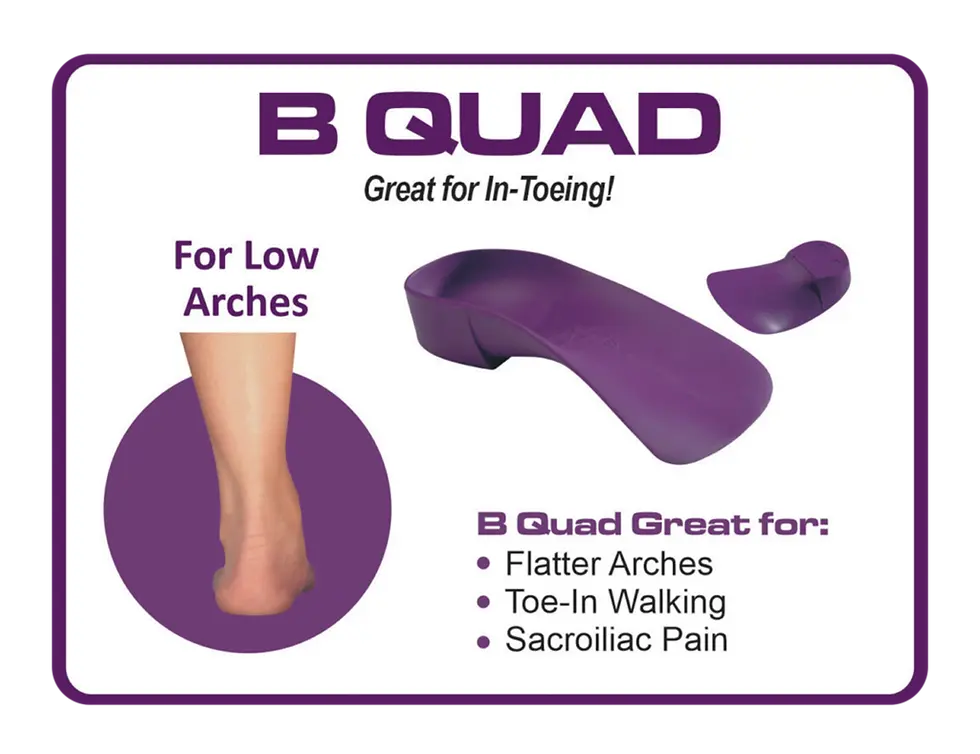
Mild Flatfoot, Often One-Sided (Mild Pes Planus)
What It Is: A mildly over-pronated foot is often seen on just one side. It may be related to leg length
Common Symptoms:
-
Lower back or sacroiliac joint pain
-
Hypermobility in the big toe joint
-
Leg length discrepancy complications
Orthotic Features:
-
Medial rearfoot posting
-
Lateral forefoot support
-
Mild medial skive for better arch control

Subtle High Arch with Toe-Out Gait
What It Is: This type shows a moderate arch with a noticeable toe-out walking pattern. Often, the foot can’t pronate properly, forcing the hips to overcompensate.
Common Symptoms:
-
Retrocalcaneal bursitis
-
Lateral hip pain
-
IT band syndrome
-
Haglund’s deformity
Orthotic Features:
-
Stabilizing rearfoot posting
-
Moderate arch support
-
Standard heel cup depth for alignment

Moderate Flatfoot (Developmental Flatfoot)
What It Is: A commonly seen type of flat foot in children and adults. It causes instability during walking and affects how the foot absorbs shock.
Common Symptoms:
Plantar fasciitis
Ball-of-foot pain (metatarsalgia)
Functional hallux limitus
Knee pain from misalignment
Orthotic Features:
Deep heel cup for control
Medial rearfoot posting
Balanced medial skive and lateral flare

Rigid, High-Arched Foot with Medial Loading Issues
What It Is: This foot has a rigid, high arch that makes it hard to balance. It’s often identified by the heel “whip” during walking and a reverse-lasted foot shape.
Common Symptoms:
Shin splints
Plantar fasciitis
Medial knee pain
Tailor’s bunion
Orthotic Features:
Lateral forefoot posting
First metatarsal head (MTH) cutout
Deep lateral heel cup
Small heel lift for added balance

Severely Flat and Flexible Foot (Pes Planovalgus)
What It Is: The most flexible and unstable foot type. This true “flatfoot” lacks structural support and places stress on the entire lower body.
Common Symptoms:
Bunions, hammertoes, and corns
Posterior tibial tendon dysfunction
Plantar fasciitis and splayfoot
Knee and ankle pain
Orthotic Features:
Deep heel cup
Large medial skive
Rearfoot and forefoot posting
First MTH cutout for pressure relief
Get Matched with the Right Orthotic Today
At Premier Podiatry Associates, we utilize the QUADRASTEP System to eliminate the guesswork from orthotic prescription. By identifying your foot type and fitting you with the correct device, we can alleviate pain, enhance function, and help you walk with greater confidence.